Qwen3.6-27B Open-Sourced: A 27B Dense Model for Coding Agents That Surpasses the Previous 397B Flagship
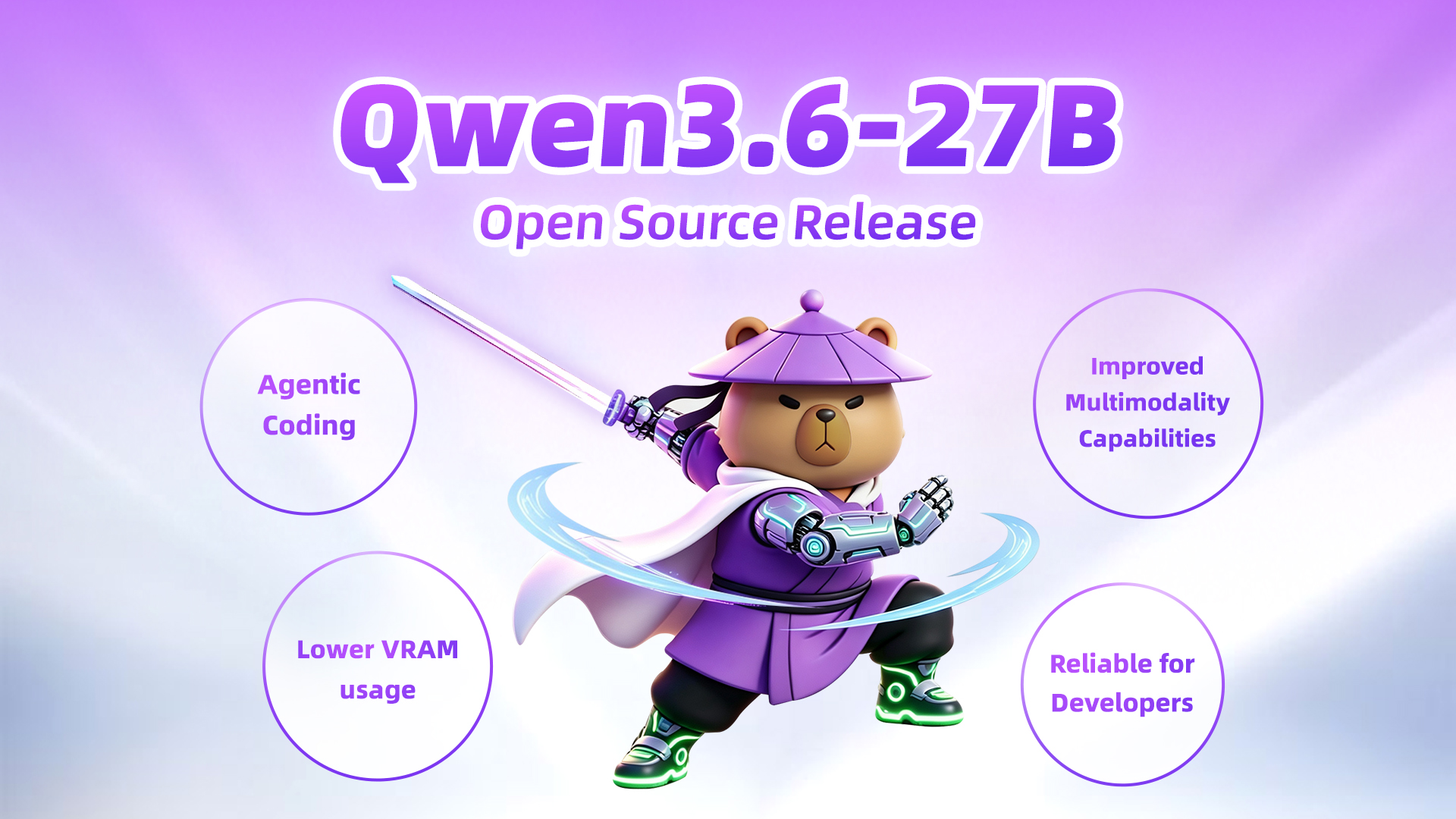
Once Qwen3.6-27B was open-sourced, it was easy to misread it as “just another 27B model.” But if you place it in the current wave of open-source model competition, the real story is not the number 27B itself.
If you look only at 27B, that figure is not particularly shocking. What is actually worth watching is something else: with a more deployment-friendly Dense architecture, it pushes coding agent capability close to flagship level—and on the official core coding benchmarks, it even surpasses the previous-generation Qwen3.5-397B-A17B flagship.
The significance of that is very practical.
In the past, many people assumed that if you wanted a strong coding agent, you had to move to a larger MoE model or accept more complex deployment costs. A lot of teams talk about chasing flagships, but then back off when it comes time to deploy. This time, though, Qwen3.6-27B offers a different answer: a 27B dense model can also be highly capable on real development tasks.
For developers, AI coding tool teams, and even enterprises preparing for private deployment, that matters more than a few extra benchmark points on a poster. Whether it can fit into an engineering workflow is the real dividing line.
Bottom line first: Qwen3.6-27B is not a typical 27B model
On April 22, 2026, the Qwen team released Qwen3.6-27B. According to the official description, it is a:
- 27B-parameter Dense model
- Multimodal model supporting text, image, and video input
- Model with both thinking and non-thinking modes
- Model with native support for 262,144 tokens of context
- Model scalable to 1,010,000 tokens
- Model released under the Apache 2.0 open-source license
Among those points, the ones that truly set it apart from a standard “mid-sized model release” are these three:
- Its coding agent capability is genuinely strong
- It is not a text-only model, but a unified multimodal model
- Its Dense architecture makes deployment and integration more practical
Many model launches say they are “good for developers.” But Qwen3.6-27B feels different because it focuses on metrics that are closer to real engineering workflows, such as SWE-bench, Terminal-Bench, SkillsBench, and NL2Repo.
These benchmarks are not about whether a model can autocomplete a short snippet of code. They are much closer to questions like these:
- Can it understand a repository?
- Can it execute actions continuously in a terminal?
- Can it complete multi-step fixes?
- Can it produce stable output in more realistic agent workflows?
Those are the coding agent capabilities people actually care about today.
Why this 27B dense model is getting so much attention
For a while now, the open-source model world has followed an implicit trend:
If you want to keep pushing capability upward, you often need either a much larger parameter count or an MoE architecture that reduces active parameters while scaling total parameters higher.
MoE clearly has major advantages, but in practice it also brings some extra complications:
- More complex deployment pipelines
- Routing mechanisms that affect service stability and tuning strategies
- Operational and inference costs that are still not low for many teams
- In real adoption, not every team wants to pay the price of architectural complexity first
That is exactly why Qwen3.6-27B stands out. It lands right on the tradeoff everyone has been wrestling with over the past two years: how do you balance capability, cost, and deployment reality?
It does not buy capability by becoming absurdly large. Instead, it compresses that capability into a more mainstream, easier-to-integrate 27B Dense framework. This size is unusually well judged:
- Large enough for flagship-level tasks
- Not so large that it can only run in a handful of environments
- More friendly for inference deployment, API services, and local or enterprise integration
If you build AI coding tools, automated development platforms, or internal enterprise knowledge engineering systems, a 27B Dense model at this scale is often much easier to put to real use than an ultra-large model.
The most important data point: it beats the previous 397B flagship on major coding benchmarks
The most eye-catching line in the official blog is not “multimodal,” and it is not “long context.” It is this:
Qwen3.6-27B surpasses the previous open-source flagship Qwen3.5-397B-A17B on the major coding benchmarks.
Why does that matter? Because Qwen3.5-397B-A17B is not an ordinary comparison target. It was an exceptionally strong open-source flagship from the previous generation, built on an MoE architecture with 397B total parameters and 17B active parameters.
And now, a 27B Dense model has pulled ahead on multiple coding agent evaluations that developers care more about.
Let’s start with the most important numbers:
| Metric | Qwen3.6-27B | Qwen3.5-397B-A17B |
|---|---|---|
| SWE-bench Verified | 77.2 | 76.2 |
| SWE-bench Pro | 53.5 | 50.9 |
| SWE-bench Multilingual | 71.3 | 69.3 |
| Terminal-Bench 2.0 | 59.3 | 52.5 |
| SkillsBench Avg5 | 48.2 | 30.0 |
| NL2Repo | 36.2 | 32.2 |
| Claw-Eval Avg | 72.4 | 70.7 |
| Claw-Eval Pass^3 | 60.6 | 48.1 |
| QwenClawBench | 53.4 | 51.8 |
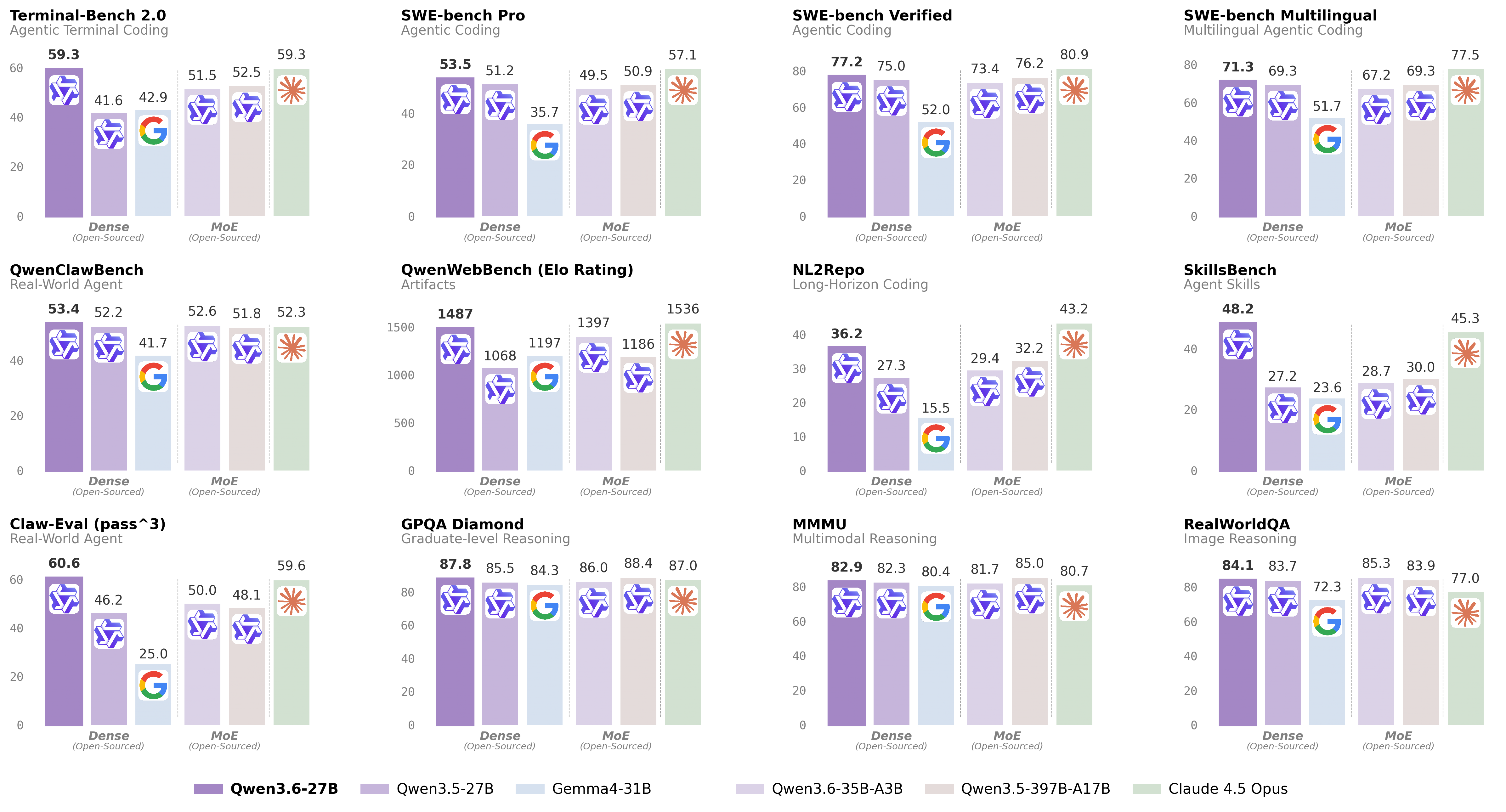
If you do not usually follow benchmarks closely, you can read these results as signals that are much closer to real development experience:
1) SWE-bench Verified 77.2
This metric measures a model’s ability to fix bugs in real software repositories. It is not simple function writing. The model has to understand the repository context, locate the problem, modify the code, and then validate the fix by passing tests.
A score of 77.2 means Qwen3.6-27B is no longer at the level of a “code completion assistant.” It is clearly moving toward a repo-level software engineering assistant.
2) Terminal-Bench 2.0 59.3
This metric is closer to agent behavior in a terminal environment.
In other words, the model is not just outputting an answer in a chat box. It needs to execute commands continuously in a terminal, read files, make edits, and handle multi-step tasks.
For today’s AI coding tools, this kind of capability matters more than one-shot code generation. Real development workflows are not designed around a single question and answer.
3) SkillsBench 48.2
This improvement is especially striking. The previous Qwen3.5-397B-A17B scored 30.0, while Qwen3.6-27B jumps directly to 48.2.
In practical terms, that often means one thing: the model behaves more like a tool that can keep working through tasks, rather than a model that merely answers questions.
4) NL2Repo 36.2
This metric is related to repository-level understanding. You can think of it as the ability to move from natural-language requirements to project-level code changes.
That matters in real development workflows, because enterprise model usage is often not about writing code from scratch. It is about making incremental changes inside an existing repo.
It is not just a coding model—it is also a unified multimodal model
Because most of the discussion around Qwen3.6-27B focuses on coding, it is easy to classify it as a “code-specialized model.”
But the official information is clear: it is a natively multimodal model that supports text, image, and video input, while also supporting both thinking and non-thinking modes.
That means its real usage boundary extends far beyond “writing code.”
For example, it is naturally better suited to scenarios like these:
- Generating front-end pages from UI design mockups
- Troubleshooting based on screenshots of errors or logs
- Reading documents, OCR content, or charts before continuing to code
- Handling agent workflows that include image and video input
The official public vision and video benchmarks also make that clear:
| Metric | Qwen3.6-27B |
|---|---|
| MMMU | 82.9 |
| MMMU-Pro | 75.8 |
| MathVista mini | 87.4 |
| RealWorldQA | 84.1 |
| MMStar | 81.4 |
| CharXiv RQ | 78.4 |
| CC-OCR | 81.2 |
| VideoMME | 87.7 |
| VideoMMMU | 84.4 |
| MLVU | 86.6 |
| AndroidWorld | 70.3 |
The key point behind these numbers is not just that “it can also look at images.”
What is really interesting is that it combines multimodal understanding and coding agent capability in the same model.
That is different from older split workflows where “the text model writes code while the vision model handles images.” The benefit of a unified model is straightforward: less context switching, and an easier time chaining together complex tasks.
For example, imagine a real task like this:
- First, inspect a product prototype image
- Then read the PRD document
- Next, generate the page code
- Then continue adjusting the UI based on screenshots
If the model itself can handle images, documents, and code, the full pipeline becomes much smoother.
Long context is not just decoration—it is more useful for real development
Qwen3.6-27B natively supports 262,144 tokens, and according to the official model card, it is scalable to 1,010,000 tokens.
If you only see that number in a launch post, it is easy to read it as “another long-context selling point.”
But in coding agent scenarios, it is genuinely practical.
Because once you put a model into a real engineering workflow, the context is no longer just the current conversation. It becomes:
- Multiple files
- Long documents
- Historical change records
- Test outputs
- Configuration files
- Design mockups and requirement documents
- Historical reasoning traces across multiple rounds of dialogue
If the context window is too short, the model starts to “forget” after a few rounds. Constraints mentioned earlier, code style, and project structure all begin to drift.
Combined with its agentic coding focus, Qwen3.6-27B’s long-context capability is more valuable than it would be in a general chat scenario.
One especially practical new feature this time: preserve_thinking
In the Qwen3.6 family, the feature I think developers should pay special attention to is the officially emphasized thinking preservation, namely preserve_thinking.
This feature is not about making the model “look more thoughtful.” It addresses a more practical question:
In multi-turn development tasks, how can a model retain the genuinely useful reasoning thread from earlier steps instead of focusing only on the latest user message each turn?
The official Hugging Face README explicitly states that Qwen3.6 received additional training to preserve and use historical thinking traces. For multi-turn development, continuous bug fixing, and long-chain tasks, that change is highly practical.
You can think of it like this:
- Better for continuous debugging
- Better for multi-round repo modification
- Better for agent workflows that need to reuse historical decisions
- Better for tasks where “the model already thought this through once and should not get lost again later”
Where many coding agents really break down is not in the first round—they break down in the third or fifth round, when they start drifting. This capability is designed to patch that weakness. And for developers, that “everything was correct at first, then suddenly went off track” feeling is exactly what they hate most.
Why the Dense architecture makes it more attractive in the real world
One of the core keywords around Qwen3.6-27B this time is Dense.
That may sound like a technical detail, but it directly affects whether a model can actually be adopted.
For many teams, model selection is not “pick whichever scores one point higher on a leaderboard.” The real questions are much more practical:
- Is deployment a hassle?
- Is inference stable?
- Is it hard to integrate into the existing toolchain?
- Is the resource cost acceptable?
- Is it easy to land in private and enterprise environments?
This is where Dense models have an advantage:
- A clearer execution path
- Lower engineering complexity
- Better compatibility with many existing inference frameworks
- Easier service-side stabilization
The official materials also clearly list deployment and integration paths across multiple frameworks, including:
- Hugging Face Transformers
- vLLM
- SGLang
- KTransformers
- llama.cpp
- MLX (Apple Silicon)
That means the value of Qwen3.6-27B is not just that “you can download it.” It genuinely has the conditions needed for developers to deploy it, expose it through APIs, and plug it into coding assistants.
It is already moving into the tooling ecosystem, not just sitting on a model page
Another point worth watching is that Qwen3.6-27B is not just a model release. It is clearly moving into the developer tooling ecosystem.
According to the official materials, its compatibility direction includes:
- Qwen Code
- OpenClaw
- Claude Code
- Alibaba Cloud Model Studio API
That means it is not aimed only at “chat experience.” It is directly oriented toward real scenarios such as terminal-based development, agent workflows, and engineering assistance.
In other words, what the Qwen team wants to push now is not “come try how smart this model is,” but rather “try plugging it into your own development toolchain.”
Once a model like this truly enters the developer tooling ecosystem, its significance changes:
- It is no longer just a model
- It starts to become an execution layer inside the development environment
- It forms a more direct relationship with IDEs, CLIs, code repositories, and testing tools
For Qwen3.6-27B, that may matter even more than one-off chat performance.
What scenarios is Qwen3.6-27B a good fit for?
If we place it in real-world usage, I think Qwen3.6-27B is especially well suited to the following types of tasks.
1. AI coding assistants
This is the most direct use case.
If you need a model that can read repositories, operate in terminals, debug continuously, and make multi-step code changes, Qwen3.6-27B is well worth trying first.
2. Internal enterprise code agents
Many enterprises do not necessarily need to chase the biggest model. They care more about practical conditions like these:
- Feasible private deployment
- Controllable cost
- Compatibility with existing engineering pipelines
- The ability to process code and documents together
A 27B Dense model has major real-world value here.
3. Multimodal development workflows
For tasks like turning design mockups into pages, debugging from screenshots, coding after document understanding, or analyzing with video and screen recordings, a unified multimodal model makes the pipeline smoother than splitting the workflow across several models.
4. Long-context engineering analysis
If you often deal with large repositories, long documents, and complex historical context, Qwen3.6-27B’s long-context capability is also a strong fit.
It still has boundaries
At this point, it is also important to be clear about the limits.
Qwen3.6-27B is very strong, but it should not be framed as one of those “it crushes everything across the board” stories. A more accurate way to put it would be:
- It performs exceptionally well on the core coding agent benchmarks highlighted by the official materials
- At the 27B Dense scale, it genuinely delivers strong engineering practicality
- It is unusually complete across multimodality, long context, and agent workflows
But that does not automatically mean:
- It is the absolute best on every task
- It is always the optimal choice in every deployment environment
- It has already solved every stability issue in coding agents
There is always a gap between a model release and real production deployment. In practice, the user experience depends not only on the model itself, but also on the toolchain, prompting, task orchestration, context management, and testing loops. There is no need to oversell it.
Even with all of those caveats, though, Qwen3.6-27B is still a release worth taking seriously.
Because it demonstrates one important point:
An open-source Dense model does not need an absurdly large scale to deliver flagship-level performance on real development tasks.
Final take on Qwen3.6-27B
If you remember only one sentence, this is how I would sum it up:
The value of Qwen3.6-27B is not just that “a 27B model got stronger.” It is that it pushes open-source Dense models significantly further forward on the coding agent frontier.
Its strength is not in one isolated point, but in the combination:
- Strong coding agent capability
- Multimodal ability that is actually useful
- Long context and thinking preservation that are genuinely practical
- A Dense architecture that makes deployment more realistic
- An integration path that is already expanding across the tooling ecosystem
For developers, the most attractive thing about a model like this is never a poster claim that it is “the strongest.” It is whether, once you plug it into your workflow, it really helps you do less repetitive work and take fewer detours.
Right now, Qwen3.6-27B looks very close to that goal.
If you are currently evaluating a more capable open-source coding model for your team, this is a version that deserves a serious test.