In this single-package test on 13 November 2026, neither processing order reliably preserved the Chinese fine print. We submitted eight requests, debited 96 credits and received a 20-credit refund, for a net cost of 76 credits. Expanding first and selecting the upscaler's “4K” tier last produced 2304 × 1296 files. Selecting “4K” first produced a 4096 × 4096 intermediate, but expanding last returned a 1280 × 720 file. One intermediate required operator recovery after normal product delivery failed.
The useful decision is therefore not simply “which order is best?” It is whether the final operation delivers the dimensions and exact wording your layout needs. For this synthetic package, keep approved label artwork and check the downloaded pixels after each operation. A sharper wrong character is still wrong.
What we tested
We used one programmatically drawn 1024 × 1024 fictional LUMA TEA package. It is not a customer photograph or a real product case. The same input artwork was used for both orders, with two repeats each:
| Chain | First operation | Second operation | Repeats |
|---|---|---|---|
| A | Uncrop landscape preset | Upscaler tier labelled “4K” | A1, A2 |
| B | Upscaler tier labelled “4K” | Uncrop landscape preset | B1, B2 |
The landscape request was 1344 × 768 with the interface label “16:9”; the request itself is not exactly 16:9. Every delivered expansion in this test was actually 1280 × 720. We report file dimensions rather than treating preset names or local configuration as output guarantees.
You can open Uncrop and open the image upscaler to review current options and separate credit costs. These links do not submit a generation. Review the price and actively start each step yourself.
The source and known text
The original PNG SHA-256 is d906048d1f4885c6d652f851f5348e8b4788a28358b838390a048a3a931bc088. Its lossless WebP preview below is a separate encoding. The source was drawn with text and geometric shapes before the test; the cover is explanatory artwork, not a model result.
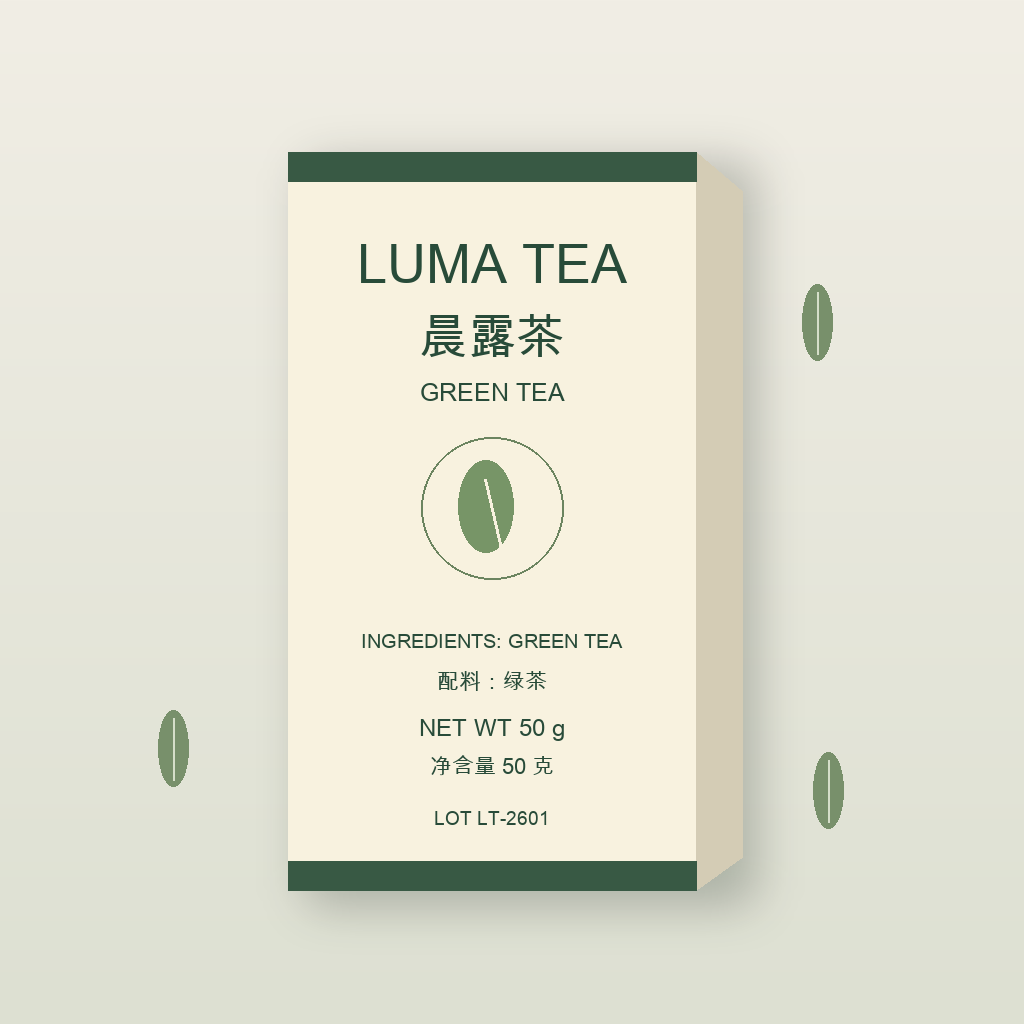
| Label line | Text fixed before testing | NFC code points |
|---|---|---|
| Ingredients, English | INGREDIENTS: GREEN TEA | 22 |
| Ingredients, Chinese | 配料:绿茶 | 5 |
| Weight, English | NET WT 50 g | 11 |
| Weight, Chinese | 净含量 50 克 | 8 |
| Batch | LOT LT-2601 | 11 |
The larger headings were “LUMA TEA”, “晨露茶” and “GREEN TEA”; they are outside the five-line fine-print score. The source label rectangle was fixed as (288, 610, 696, 850), with the right and bottom edges excluded. Corresponding output crops require locating the package again because the composition and scale change; they are not identical pixel coordinates or an exact registration.
Native dimensions, delivery and cost
The original downloads show why the last operation matters:
| Repeat | Intermediate pixels | Final pixels | Gross credits debited | Complete workflow elapsed time |
|---|---|---|---|---|
| A1: expand → upscale | 1280 × 720 | 2304 × 1296 | 4 + 20 = 24 | 80.413 s |
| A2: expand → upscale | 1280 × 720 | 2304 × 1296 | 4 + 20 = 24 | 90.897 s |
| B1: upscale → expand | 4096 × 4096 | 1280 × 720 | 20 + 4 = 24 | 108.720 s |
| B2: upscale → expand, recovered intermediate | 4096 × 4096 | 1280 × 720 | 20 + 4 = 24 | 819.906 s, including recovery wait |
Workflow elapsed time runs from the first generation request to the first observation that the second step completed. It includes the intervening normal upload, queueing and polling; it excludes the upload before the first request and the final download. These are observed workflow times, not model inference times. B2 includes operator intervention and cannot support a normal speed comparison. Two repeats do not estimate typical latency.
Read-only credit reconciliation found one debit for each of the eight tasks: 96 credits debited. The account reached zero after the eighth request. At the 20:49 Beijing-time recheck, B2's failed first step had been refunded to the original grant: 20 credits returned, 76 net spent, 20 remaining. We made no further requests. Credits are not a cash price. This was the eight-request limit; no additional generation replaced a failed delivery.
Product delivery was 7/8 steps, not 8/8. B2's first step produced an approved image but failed to complete its normal product delivery. An operator recovered that same task's PNG and supplied a metadata-free WebP for the next normal upload. We encoded the recovered PNG as lossy WebP and then removed its metadata without changing the decoded WebP pixels. On B1, the same encoding procedure reproduced its delivered WebP byte for byte. The deleted B2 delivery file was unavailable for direct comparison. The public B2 intermediate is therefore a recovered derivative, not an untouched product download. Three of the four two-step repeats completed without this recovery; B2 did not.
What happened to the small text
An independent reviewer transcribed all four final images before reading the source text truth. The identifiers revealed the chain, so this was not a double-blind review. The first reviewer transcribed the three English lines as matching the truth in all four finals. However, A1’s batch number had a material reading disagreement: that reviewer read 2601, while another reader initially read 2801; the digit shaped like 6 can also resemble 8. We retain both observations rather than declaring either reading uniquely correct. The two Chinese lines contained uncertain or changed glyphs; no final established that all five lines were preserved exactly.
In A1 and A2, the reviewer read the Chinese weight line as “净食量 50 克”, with “食” where the source has “含”; the final character in the ingredients line could not be read confidently. B1 and B2 had different uncertain Chinese glyphs and block-like or joined strokes. These observations do not establish that one order preserves Chinese text better: the native final dimensions differ, the sample is synthetic, and B2 required recovery.
The assessment uses Unicode NFC and preserves case, full-width characters, spaces and punctuation. For a fully transcribed line, insertion, deletion and substitution each cost one in Levenshtein edit distance. The five truth lines total 57 code points. Uncertain glyphs or spacing remain uncertain; no single total accuracy percentage is reported. The record is a visual transcription check, not an OCR benchmark or a consumer readability study.
For A1’s disputed batch line, the two stated readings imply an edit distance of 0–1 over 11 truth code points; this range does not resolve the glyph. A1 and A2’s Chinese weight line has distance 1 over 8 under the reviewer’s single-space transcription convention. Their ingredients line and B1/B2’s two Chinese lines are not reliably quantifiable because of unresolved glyphs or spacing. We do not collapse these observations into a 57-character total score.
How to read the comparison images
The full-image equal-display view places the source and four finals into equal viewing frames. The label equal-display view uses corresponding manually located label regions and a documented deterministic resize. A separate native-pixel label sheet does not interpolate the cropped pixels, but a responsive webpage can still scale the sheet. Download it or the individual originals to inspect file pixels; the embedded view is not proof of 100% display.
Equal display helps inspection; it does not make these matched-resolution model tests. The files have different pixel counts and package scales. Cropping or resizing does not restore lost letters, and there is no third upscale step after B's final expansion.
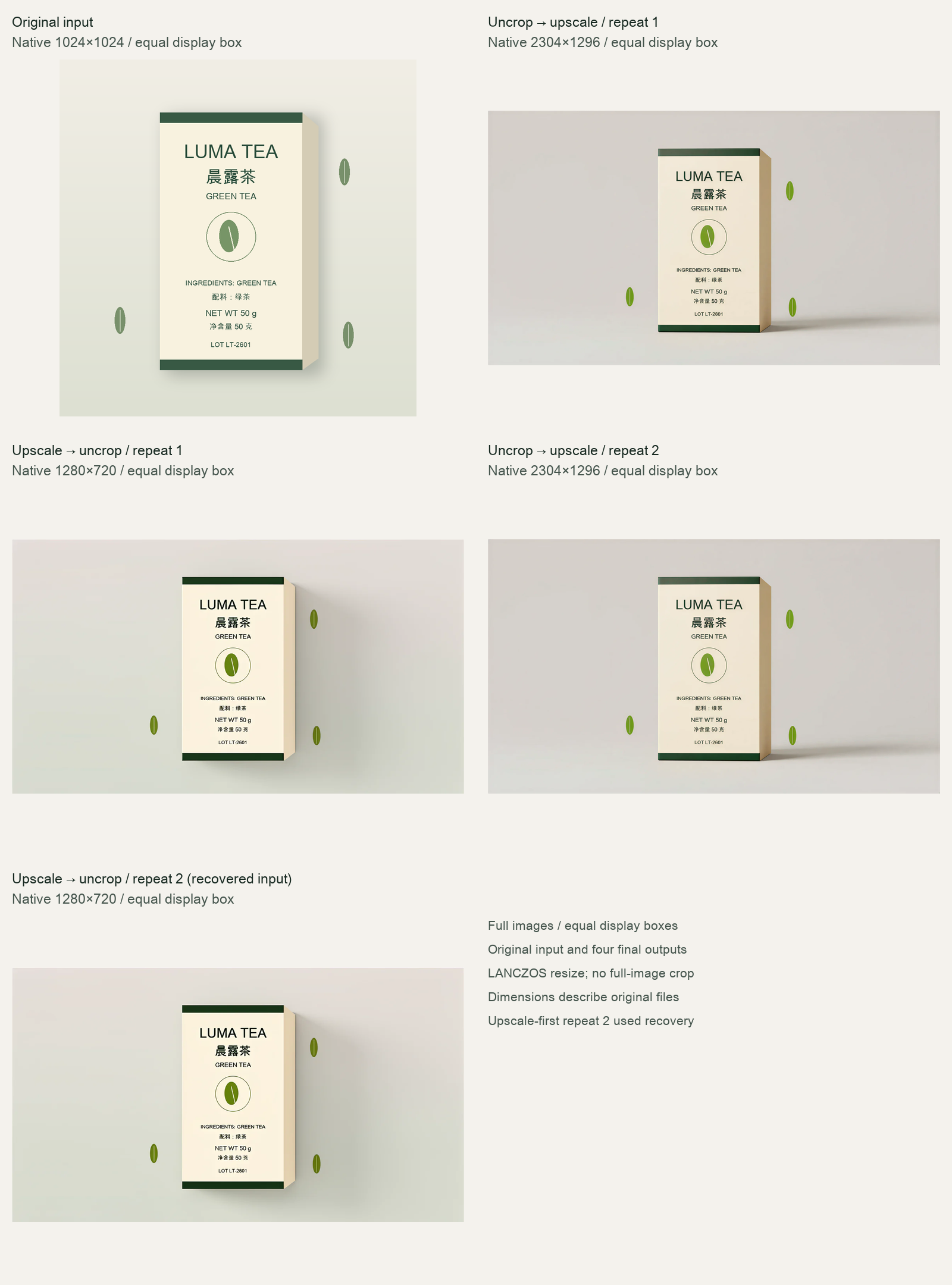
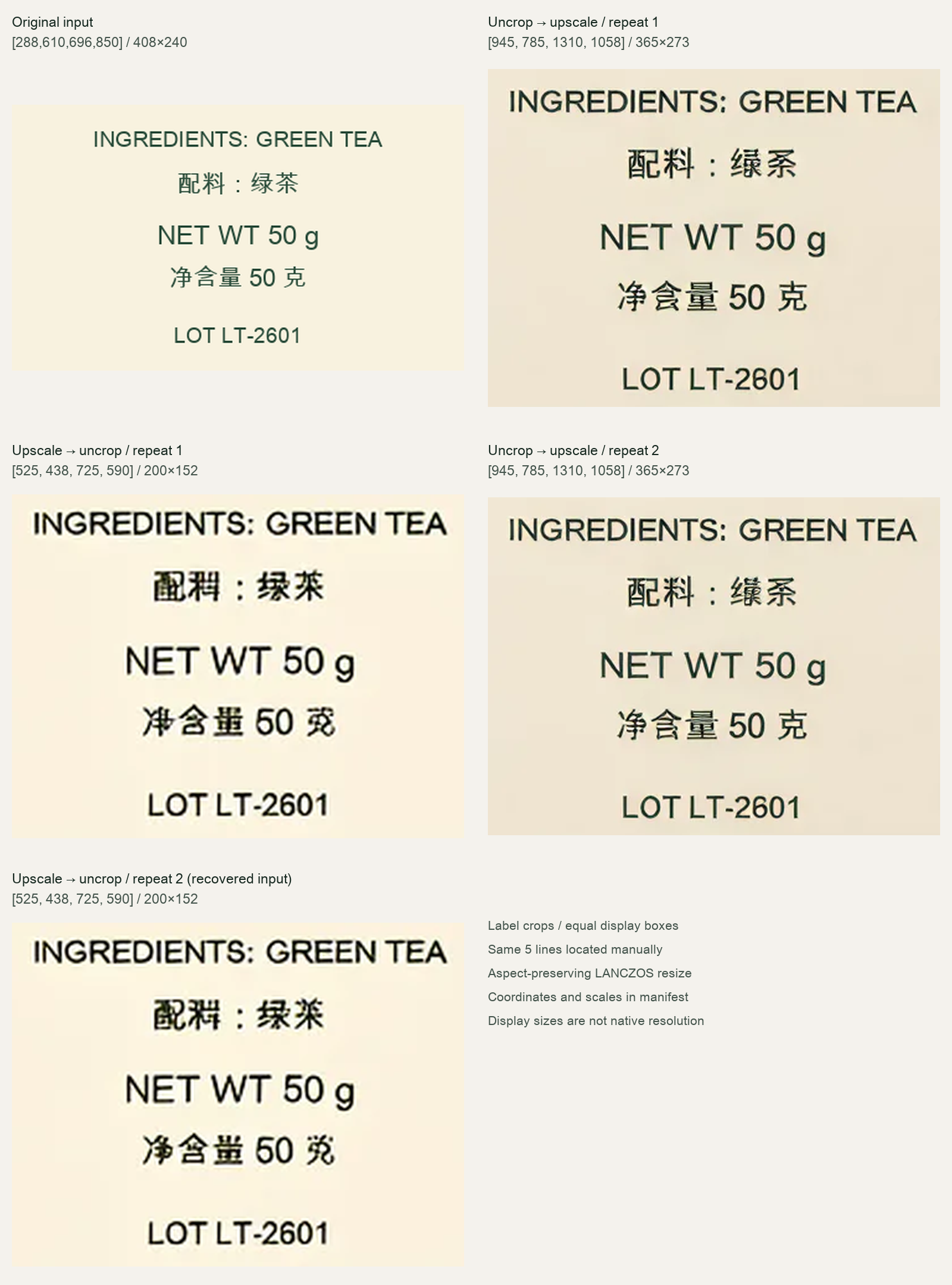
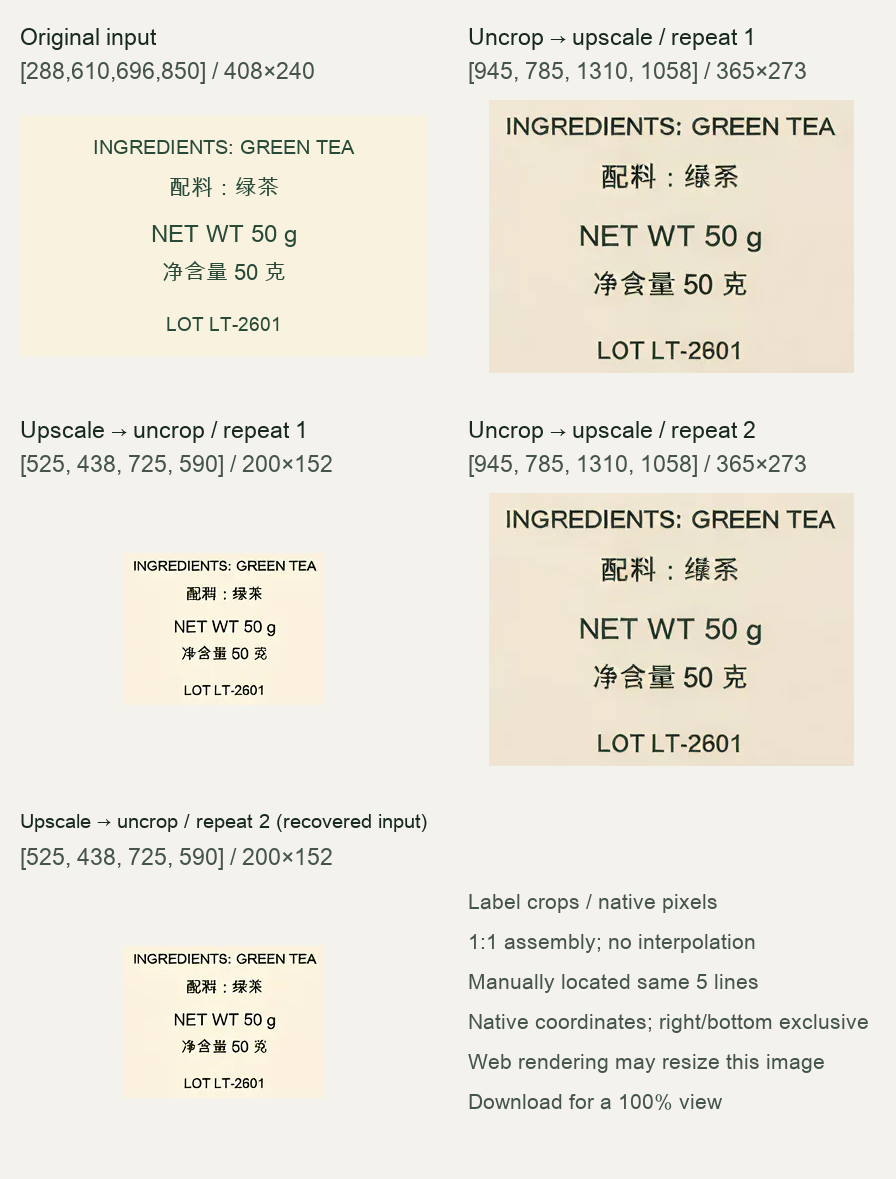
Every intermediate and final file
Seven links below preserve the normal product download bytes. B2-step1 is the recovered, metadata-free derivative described above. These links are separate from the resized comparison sheets.
Processing conditions and limits
- Each step used normal upload and content review. The upload service converts submitted images to lossy WebP at quality 85. The lossless source preview is not evidence that unchanged PNG bytes reached the model; this is a hosted workflow test, including its upload processing.
- No seed parameter was sent. Uncrop exposes no user seed; the ordinary upscale interface does not expose the API's seed option. The service assigned task seeds, but they do not prove deterministic reruns. A1 and A2's expansion intermediates were byte-identical even though the tasks and debits were separate; the two final files had different bytes.
- Upscale task records were labelled
seedvr2; expansion records carried the aspect-ratio label. These database labels and public page descriptions do not establish the exact checkpoint or full runtime workflow version. We do not claim a model-versus-model benchmark. - The requested “4K” tier produced different actual dimensions for these input shapes. The landscape finals were not 4096 pixels wide. Verify your downloaded file instead of assuming a tier name guarantees a size.
- One source, two repeats per order and one recovered step cannot establish general reliability, commercial label suitability or universal workflow superiority. No conversion, sales or production-scale benefit was measured.
A practical choice for this example
If you need a larger landscape file, ending with enlargement produced more pixels than ending with Uncrop in this test. It did not prove exact fine-print preservation, and even the “4K” selection did not deliver a 4096-pixel landscape file here. If wording is mandatory, retain approved label artwork or add verified text in a conventional editor rather than accepting generated lettering.
For online processing and local restoration or tiled-diffusion options, read the Z-Image Turbo upscaling guide. Keep intermediate files, confirm each operation's actual output and cost, and reject altered labels for uses that require exact text. This conclusion applies to this one synthetic package and these observed tasks.